Sunday, January 27, 2013

General Update #2 and News About Basic Edition D&D

I had hoped to bring you a substantive post today, but the one I was working on was a look back at previous campaigns in an attempt to draw out the things I did right, but it wasn't feeling right for some reason.  Still can't really put my finger on it but in part I believe it's because I want this blog to be about moving forward and moving on, not the past.  So that rather massive post is history, in every sense of the word.

So that decision has left me without a post and for that I apologize.  And perhaps I should have just let that be, and not posted this filler piece, but while looking around on the web for some inspiration on what to write about I dropped by my favorite online shops and was delighted to see that the Basic Edition D&D rulebook is a top seller; No.1 and No. 2 respectively at RPGNow.com and DriveThruRPG.com.

I am so amazed and happy about that, I just had to say something.

Thursday, January 24, 2013

Ring of Spell Holding

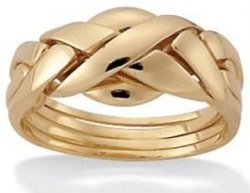
This intricate gold band, when slipped on a character's finger, extends the duration of a spell in effect on the character indefinitely - as long as the ring is worn.  Only spell effects that have a duration other than 'Instantaneous' can be so held.  If the ring is removed once the spell's normal duration has expired, the spell effect ceases immediately.  Eighty-five percent (85%) of these rings work on Magic-User spells only.  Rarely (15%), such rings will work with both Magic-User and Cleric spells.  One such ring can maintain only a single spell effect, so if a character has Flight, Protection from Evil and Bless in effect when the player indicates that the character puts on the ring, the player must specify which of the effects will be held.  The other effect(s) dissipates normally at the end of the spell's normal duration.

Tuesday, January 22, 2013

WoTC Makes Basic-edition D&D Avavilable Again!


I thought I might post a magic item or two today; hoping to get into a regular rhythm here (Tues-Thurs-Sun) but it turns out I really have something much better to write about!

Today Wizards of the Coast has started re-releasing the .pdf versions of previous editions of Dungeons & Dragons, including Moldvay's edition of the D&D Basic Set Rulebook!  Previously they had only released the Mentzer (BECMI) edition of the D&D Basic Set.   This is a quality scan and has been nicely cleaned up, unlike the pirate fan-scans available out there, and the text is selectable as well.  The price is acceptable too, only $4.99 for the rulebook.  I bought my original hardcopies in the boxed sets for $12.00 each back in the day, of course that included the cheapo dice-set with crayon to fill-in the numbers and an adventure module (B2 and X1 respectively).  Now all I need is the matching Expert volume and I am good-to-go!

This is terrific news for those of us die-hard Basic/Expert fans.  And a step in the right direction by WoTC.  Perhaps they've been paying attention after all...?

As the D&DClassics.com site has been up and down due to traffic here's a backup link to the Basic Rules, just in case...

Sunday, January 20, 2013

The Huntsman


Huntsmen are humans who have left the comforts of civilization for the challenges of surviving in the wilds.  They often protect rural communities from wild animals, beasts and monsters.  Because of their wilderness survival skills and the power of their animal companions huntsmen often can be found in adventuring parties.

The prime requisites for a huntsman character are Strength and Intelligence.  If a huntsman has scores of 13 or better in both Strength and Intelligence, the character will gain a 5% bonus to earned experience.  If the huntsman's Strength is 13 or better and his or her Intelligence is 16 or better, the character will earn a 10% bonus on earned experience.

RESTRICTIONS: Huntsmen use six-sided dice (d6) to determine their hit points. They may wear nothing more protective than leather armor, and may not use a shield. They may, however, use any type of weapon.  A huntsman’s combat ability progresses as a Cleric.  A huntsman character must have a minimum Intelligence score of 9.

SPECIAL ABILITIES: If a huntsman surprises a target, usually by making a successful Move Silently or Hide in Terrain roll, he gains a +4 bonus to hit and inflicts double damage with any ranged weapon during the surprise round.  At 3rd level huntsmen may tame and train an animal companion who will fight for and beside them.  Only normal or giant animals can be tamed and the animal’s hit dice cannot be greater than the huntsman’s level.  A huntsman's skills includes learning how to plan ambushes and set snares, survive in specific environments, move silently in natural settings, hide in terrain, read tracks, remove snares, pitfalls and other natural traps and spot ambushes, and how to hear noises in the wild better than other humans.

Advancement:

Level


1
0
 Skinner
2
1440
 Trapper
3
2880
 Wrangler
4
5760
 Seeker
5
11520
 Tracker
6
24000
 Stalker
7
48000
 Hunter
8
96000
 Huntsman
9
192000
 Master Huntsman
10
336000
10th level Master Huntsman
11
480000
11th level Master Huntsman
12
624000
12th level Master Huntsman
13
768000
13th level Master Huntsman
14
912000
14th level Master Huntsman
  

Huntsman Skills
Character Level
Read Tracks
Detect Ambush/Trap
Set-up Ambush/Trap
Move Silently
Survival
Hide in Terrain
Hear Noise
1
15%
10%
20%
20%
87%
10%
1-2
2
20%
15%
25%
25%
88%
15%
1-2
3
25%
20%
30%
30%
89%
20%
1-3
4
30%
25%
35%
35%
90%
25%
1-3
5
35%
30%
40%
40%
91%
30%
1-3
6
45%
40%
45%
45%
92%
35%
1-3
7
55%
50%
55%
55%
93%
45%
1-4
8
65%
60%
65%
65%
94%
55%
1-4
9
75%
70%
75%
75%
95%
65%
1-4
10
85%
80%
85%
85%
96%
75%
1-4
11
95%
90%
95%
95%
97%
85%
1-5
12
96%
95%
105%
96%
98%
90%
1-5
13
97%
97%
115%
98%
99%
95%
1-5
14
99%
99%
125%
99%
99%
99%
1-5

Most of the above skills should be self-evident save one, Survival.  Survival is a huntsman’s ability to forage for food, build shelters, or find their way in the wilderness.  Should the huntsman use this skill to hunt, a successful roll means they have found enough food to feed 1d6 individuals.  The player should specify the type of terrain in which their character is skilled in Survival; Polar, Temperate, Tropical or Arid.  Usually the terrain type should match the campaign setting but this need not be the case.

If the hit dice of a huntsman’s animal companion are less than his level, a huntsman can control additional animals as long as the combined total of companion hit dice does not exceed the huntsman’s level.  Additional animals should be of the same type, say a pack of hounds or pair of giant ferrets, as mixing animal breeds only results in trouble.

At 9th Level a huntsman can build a lodge, attracting 2d4 1st level huntsmen to learn under the master.  These hunters are completely loyal to the owner of the lodge and should be replaced if lost to death or when they leave after achieving 3rd level (Wrangler).  The DM should roll a d6 to determine the number of weeks before a likely replacement candidate appears.  As the presence of a hunting lodge reduces the likelihood of wild animal attacks and helps to control the population of monsters rampaging through an area, huntsmen are welcomed by rulers of all stripes in helping to clear and control former wilderness.

General Update #1

You're probably wondering where the posts about the campaign are, after all that's what it says at the top, right?  I'm buying time with these posts while I try to absorb the material in Matt Finch's Tome of Adventure Design (ToAD) and the sandbox stuff from Kevin Crawford's Red Tide.  Buying or wasting it, I can't be sure which.  I do know that several of the blogs I read have said very complimentary thing about the ToAD book.  I am also working on answers for Jeff Rients' and Brendan's Twenty Quick Questions (making it Forty Quick Questions really) before committing anything to blog.  So I guess the truth is I'm still trying to get it straight in my head first.

In the meantime, I hope you'll settle for another player character class that I know I want to use...

Wednesday, January 16, 2013

Headless

Cross-pollenization of D&D with CRPGs is always fun and recruiting your favorite monsters from other sources can really help personalize your campaign.  From the Ultima series of PC games comes the…


Headless                                                    


Armor Class:         3                                  No. Appearing:     1-6 (4-24)
Hit Dice:                  5                                  Save As:                   Fighter: 6
Move:                        120’ (40’)                   Morale:                    10
Attacks:                   2 fists or                     Treasure Type:     V
                                    1 weapon                   
Damage:                  1d3/1d3/+1d6           Alignment:             Chaotic
                                    or weapon

Headless resemble hirsute, lithe and wiry humans in almost every way, except for the glaring lack of a neck or head.  They are said to be the result of experiments by an unnamed mage. Despite their lack of eyes and ears, headless have no trouble sensing their surroundings and are apt fighters.  If a headless hits with both hands on the same victim in one round of combat, the headless is throttling its victim and will cause 1-6 (1d6) additional points of damage in the same round as the fist attacks.  This additional damage will continue each round after the first as the headless strangles the life from its victim, this continues until either the headless or the victim are dead.  Headless tend to pick up the pouches and sacks of their fallen foes.  If headless are detected by characters before entering the range at which these abominations can detect prey (about 60 feet), it can be a simple matter to avoid a pack of these brutes by implementing silence in the party and keeping a discreet distance.  Headless are immune to spells or magical devices that affect the mind (such as Charm Person, Hold or Sleep) or senses (you cannot blind one by use of a Light spell, for example).

Attribution:

The Ultima game series and Headless are the creation of Richard Garriott, aka Lord British, and property of Electronics Arts (EA).  Presentation of that property here should be considered Fair-Use and does not represent an attempt to dispute ownership.